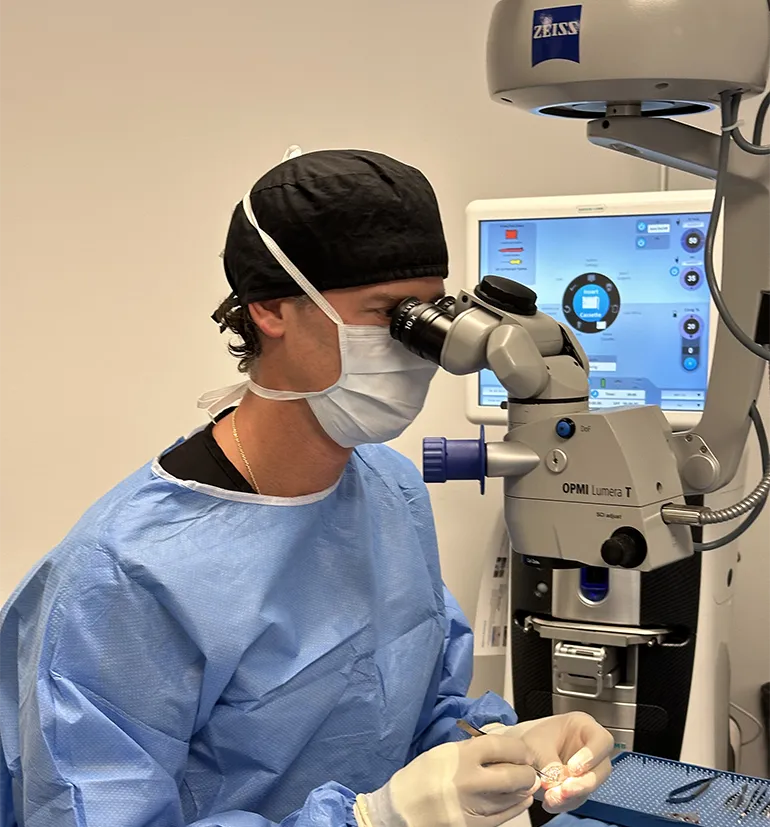
Can Thin Corneas Get LASIK? PRK and Other Options
Being told that your corneas are too thin for LASIK can be disappointing—especially if you've spent years looking forward to life without glasses or contact lenses.
But being told you're not a good candidate for LASIK does not necessarily mean you're out of options for vision correction.
Corneal thickness is an important part of determining whether LASIK can be performed safely. For patients whose corneas are too thin for traditional LASIK, alternatives such as PRK and EVO ICL may provide another path to clearer vision.
At Holzman Laser Vision, Dr. Andrew Holzman evaluates more than whether a patient simply "qualifies" for LASIK. The goal is to determine which vision correction procedure is best suited to that patient's eyes, prescription, lifestyle, and long-term eye health.
For patients throughout Northern Virginia, Washington, D.C., and Maryland, that can mean discovering options they didn't realize were available after being turned down for LASIK elsewhere.

Why Does Corneal Thickness Matter for LASIK?
LASIK corrects vision by reshaping the cornea, the clear front surface of the eye.
During the procedure, a thin corneal flap is created. An excimer laser then removes a precisely calculated amount of underlying corneal tissue to change how light enters the eye and focuses on the retina.
Because LASIK permanently removes some corneal tissue, enough healthy cornea must remain afterward to maintain the eye's structural stability. This is why corneal thickness requirements are an important part of determining LASIK candidacy.
However, there isn't one universal corneal thickness number that automatically determines whether someone can or cannot have LASIK. Dr. Holzman also considers factors such as:
- Your overall corneal shape and health
- Your prescription
- How much tissue would need to be removed
- The planned treatment zone
- Corneal topography and tomography
- Signs of corneal irregularity or weakness
- The amount of corneal tissue expected to remain after treatment
Two people can therefore have similar corneal thickness measurements but receive different recommendations.
The question isn't simply, "How thick is my cornea?" The more important question is, "Can my cornea safely support the treatment required to correct my vision?"
Can You Still Get LASIK With Thin Corneas?
Sometimes.
Having thinner-than-average corneas does not automatically disqualify someone from LASIK. If the prescription is relatively modest, the cornea is otherwise healthy, and enough tissue would remain after treatment, LASIK may still be an appropriate option.
For other patients, however, proceeding with LASIK would require removing more tissue than the surgeon considers safe.
That's an important distinction. A surgeon recommending against LASIK isn't necessarily saying your vision can't be corrected. They're saying that LASIK may not be the safest way to correct it.
At that point, the conversation should shift from "Can I get LASIK?" to "Which vision correction procedure is best for my eyes?"
For many patients, the answer may be PRK or EVO ICL.
PRK for Thin Corneas
PRK (photorefractive keratectomy) is one of the most established alternatives to LASIK and may be particularly useful for certain patients with thinner corneas.
LASIK and PRK both use an excimer laser to reshape the cornea and correct refractive errors such as nearsightedness, farsightedness, and astigmatism. The major difference is how the surgeon accesses the tissue being reshaped.
With LASIK, a flap is created in the cornea.
With PRK, no corneal flap is created. Instead, the thin outer layer of the cornea, called the epithelium, is removed so the laser can reshape the underlying tissue. The epithelium then naturally regenerates during healing.
Because PRK eliminates the need to create a LASIK flap, it preserves more of the cornea's structural tissue. That can make PRK for thin corneas an option for some patients who aren't ideal LASIK candidates.
What Are the Advantages of PRK?
For the right patient, PRK offers several important benefits. It can provide excellent vision correction without creating a corneal flap and may be appropriate for patients whose corneal thickness or lifestyle makes LASIK less desirable.
PRK may also be considered for people involved in occupations, sports, or activities where direct trauma to the eye is more likely.
The long-term visual goals of PRK and LASIK are similar. The biggest difference patients tend to notice is the recovery.
PRK Recovery vs. LASIK Recovery
LASIK is known for its rapid recovery, with many patients experiencing substantially improved vision by the following day.
PRK requires more patience.
Because the surface epithelium needs time to regenerate, the first several days can involve discomfort, light sensitivity, tearing, and blurry vision. A temporary bandage contact lens is generally placed over the eye while the surface heals.
Vision then continues to improve over the following weeks.
For someone who is an excellent candidate for LASIK, its faster recovery may make it preferable. But for someone whose corneal anatomy makes LASIK less appropriate, accepting a longer PRK recovery can be a worthwhile tradeoff for achieving vision correction in a way that better suits the eye.

What If My Corneas Are Too Thin for PRK?
PRK still corrects vision by removing and reshaping corneal tissue. If your corneas aren't appropriate for corneal laser surgery—or if other aspects of your prescription or anatomy make laser treatment less desirable—Dr. Holzman may recommend evaluating a procedure that doesn't rely on reshaping the cornea at all.
This is where another important option enters the conversation: EVO ICL.
EVO ICL: Vision Correction Without Removing Corneal Tissue
EVO ICL, or the EVO Implantable Collamer® Lens, takes a fundamentally different approach from both LASIK and PRK.
Rather than changing the shape of the cornea, EVO ICL places a specially designed corrective lens inside the eye. The lens works with your natural eye to correct vision while leaving the natural lens in place.
No corneal tissue needs to be removed to provide the refractive correction.
That makes EVO ICL an especially important LASIK alternative for patients with thin corneas, depending on their prescription, age, eye anatomy, and other candidacy requirements.
EVO ICL can also be particularly attractive for patients with moderate to high levels of nearsightedness, where laser correction could otherwise require significant corneal tissue removal.
PRK vs. EVO ICL for Thin Corneas
Neither procedure is automatically "better." They solve the problem differently.
PRK reshapes the cornea without creating a LASIK flap. It may be an excellent option when the cornea can safely tolerate laser treatment but isn't ideally suited for LASIK.
EVO ICL does not reshape the cornea. Instead, vision is corrected with an implantable lens, making it possible to avoid removing corneal tissue for the refractive correction.
Which option makes more sense depends on factors including:
- Corneal thickness and shape
- Your prescription
- Your age
- Nearsightedness and astigmatism
- Eye anatomy
- Overall eye health
- Lifestyle
- Recovery preferences
- Long-term vision goals
This is why a comprehensive evaluation is more valuable than simply looking at a corneal thickness measurement.
Why Was I Told I Couldn't Have LASIK Somewhere Else?
If you've already had a LASIK consultation and were turned down because of thin corneas, you may wonder whether getting a second opinion is worthwhile.
It can be—but the purpose of a second opinion shouldn't simply be finding a surgeon willing to perform LASIK.
The goal should be finding out why LASIK was ruled out and whether another procedure can safely accomplish your vision goals.
Modern vision correction is no longer limited to one procedure. Depending on the patient, Dr. Holzman can evaluate LASIK, PRK, EVO ICL, and other approaches rather than trying to make every eye fit the same treatment.
In some cases, the original recommendation against LASIK will absolutely be the right one. A second evaluation may confirm it.
But that evaluation may also reveal that not being a LASIK candidate doesn't mean you're not a vision correction candidate.
What Happens During a Thin-Cornea Vision Correction Evaluation?
Determining candidacy involves considerably more than checking your glasses prescription.
Dr. Holzman and the clinical team evaluate the cornea in detail, including its thickness, shape, curvature, and overall structural characteristics. Advanced diagnostic measurements help identify subtle irregularities that may influence which procedure is safest.
Your prescription and the amount of correction required are also considered alongside your age, eye health, lifestyle, and vision goals.
The result isn't simply a yes-or-no answer about LASIK. The objective is to determine which option offers the best balance of visual outcome, safety, and long-term stability for your individual eyes.
You can also learn more about how Holzman Laser Vision approaches advanced vision correction options across different ages, prescriptions, and visual needs.
Frequently Asked Questions About Thin Corneas and LASIK
How thin is too thin for LASIK?
There is no single corneal thickness measurement that determines LASIK candidacy for every patient. Your surgeon must consider your starting corneal thickness, prescription, corneal shape, treatment requirements, and how much healthy tissue will remain afterward.
Is PRK safer than LASIK for thin corneas?
PRK may be more appropriate for certain patients with thinner corneas because it doesn't require creation of a LASIK flap. However, PRK still removes corneal tissue, so corneal thickness and health must still be evaluated carefully.
Can PRK give me the same vision as LASIK?
For appropriately selected patients, both procedures can provide excellent visual outcomes. The major difference is that PRK generally has a slower initial recovery.
What happens if my corneas are too thin for both LASIK and PRK?
EVO ICL may be an option because it corrects vision without removing corneal tissue. Whether you're a candidate depends on your prescription, age, eye anatomy, and overall eye health.
Does EVO ICL permanently change my cornea?
EVO ICL does not reshape the cornea to provide vision correction. Instead, a corrective lens is implanted inside the eye while the natural lens remains in place.
Should I get a second opinion if I was rejected for LASIK?
If you want to better understand your options, a second evaluation can be worthwhile. The objective shouldn't be to find someone who will perform LASIK regardless of your anatomy, but to determine whether LASIK, PRK, EVO ICL, or another approach is most appropriate for your eyes.
Can I have thin corneas and otherwise healthy eyes?
Yes. A thin cornea is not necessarily an unhealthy cornea. Corneal thickness is only one part of the evaluation, which is why detailed diagnostic testing is important before recommending any vision correction procedure.
Told You Can't Have LASIK? You May Still Have Options
Hearing that you aren't a LASIK candidate can sound definitive. In reality, it may simply mean that LASIK isn't the right procedure for your eyes.
PRK may provide laser vision correction while avoiding the creation of a LASIK flap. EVO ICL may offer another solution without removing corneal tissue for vision correction at all.
The important part is choosing the procedure based on your individual anatomy rather than trying to make your eyes fit a particular technology.
For patients in Northern Virginia, Washington, D.C., and Maryland who have been told their corneas are too thin for LASIK, Dr. Andrew Holzman can perform a comprehensive evaluation and explain which options may be appropriate.
If you've previously been told "no" to LASIK, schedule a vision correction consultation with Holzman Laser Vision to find out what other possibilities may be available.